Many plants inherit preventive maintenance programs instead of designing them. The program grows one task at a time: an OEM recommendation, an audit finding, a past failure, a supervisor preference, a technician habit, a copied asset template. Years later, the CMMS may contain hundreds or thousands of PM lines that nobody can clearly defend.
This creates a dangerous illusion. The organization can report high PM compliance while the same assets continue to fail. The schedule is being executed, but the failure mechanisms are not necessarily being controlled.
PM compliance and PM effectiveness are different measurements
PM compliance answers whether scheduled preventive work was completed within the organization’s defined timing window. That is useful. It tells leaders whether the execution system is honoring the preventive schedule.
It does not prove the tasks were technically effective.
A technician can complete a PM exactly on time and still perform work that is vague, duplicated, unnecessarily intrusive, too frequent, too infrequent, or unrelated to the failure mode that actually causes downtime. A strong PM program therefore measures execution discipline and maintenance effectiveness separately.
When a site tells me PM compliance is high but reactive work is still dominating the floor, I do not start by attacking compliance. I start asking what the PMs are actually designed to catch. A well-executed wrong task is still the wrong task.
SMRP describes preventive maintenance as scheduled work intended to avoid, delay, or detect the onset of failure, and its broader maintenance guidance emphasizes effective, cost-conscious maintenance and reliability systems. Reliability-centered maintenance standards take the same discussion deeper by tying maintenance decisions to functions, failures, failure modes, effects, and appropriate failure-management policies. The current SAE JA1011 revision was issued in November 2024. The U.S. Department of Energy also describes RCM as a structured process for determining optimal failure-management strategies based on reliability characteristics and operating context.
Start with the failure mode, not the calendar
The most useful question in PM optimization is not, “How often should we do this PM?” It is, “What failure are we trying to prevent, detect, or control?”
A failure mode describes the specific way a component, asset, or function can fail. On a conveyor gearbox, “gearbox failure” is too broad to be useful. Failure modes might include lubrication degradation, lubricant contamination, bearing wear, seal deterioration, misalignment, gear tooth damage, looseness, or overload-related damage.
Those failure modes do not necessarily respond to the same maintenance task. That is why copying a generic monthly inspection across every asset is not a maintenance strategy.
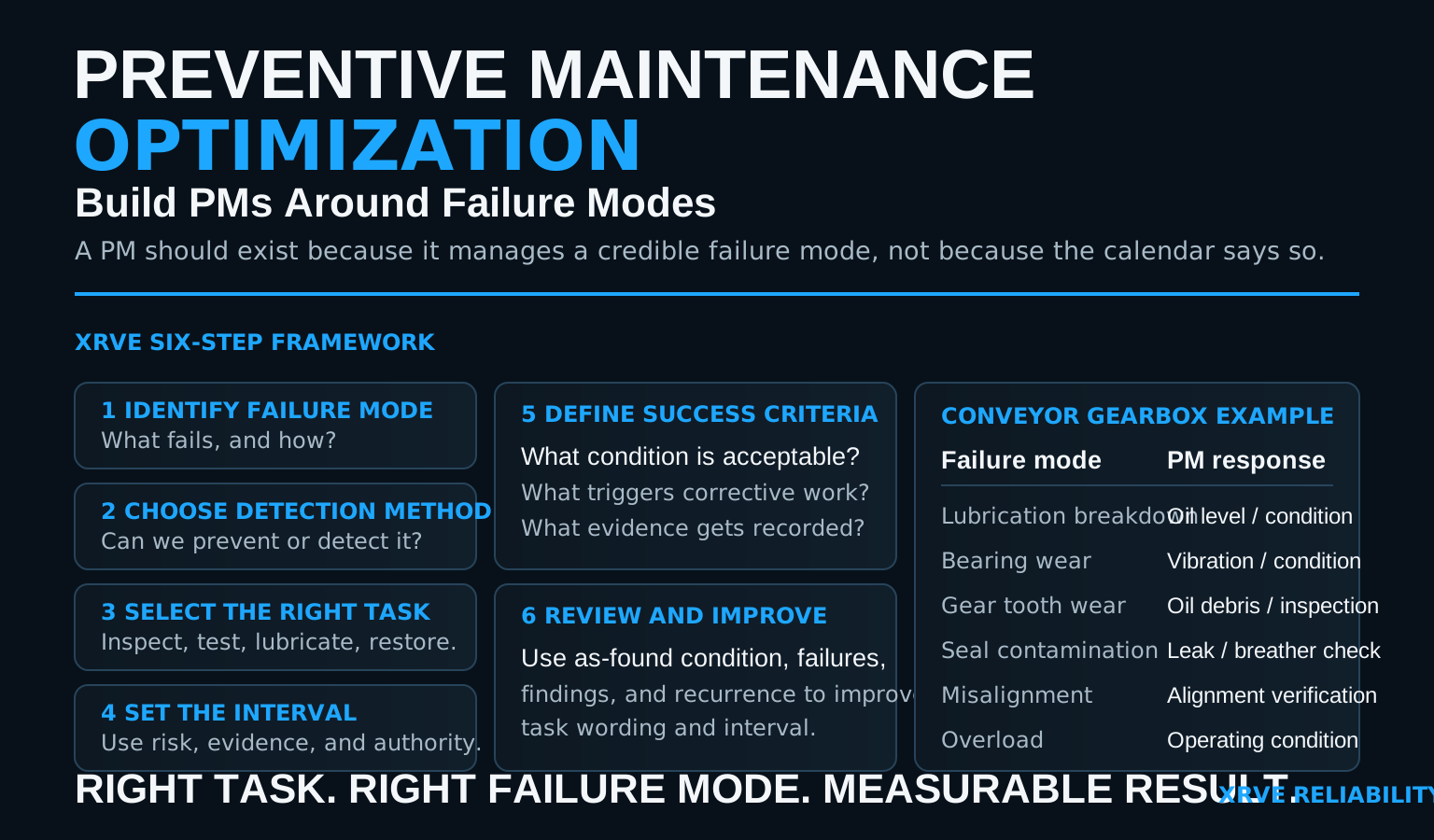
The six-step PM optimization framework
1. Identify the function and credible failure mode
Start with what the asset or component is required to do in its current operating context. Then identify the ways that function can be lost or degraded.
Do not build the list from imagination alone. Use actual failure history, technician knowledge, OEM information, engineering documentation, existing FMEA or RCM work, defect history, and operating conditions. The word credible matters. A theoretical failure that is not relevant to the operating context should not automatically generate maintenance work.
2. Select a maintenance policy that matches the failure behavior
Different failure mechanisms call for different responses. The strategy may be a condition-based inspection, predictive technology, lubrication task, functional test, scheduled restoration, scheduled replacement, operator care task, redesign, or deliberate run-to-failure policy.
| Failure behavior | Possible maintenance response | Key question |
|---|---|---|
| Deterioration can be detected before functional failure | Condition inspection, vibration, oil analysis, thermography, ultrasound, measurement | Can the condition be detected early enough to act? |
| Failure probability increases with age or use | Scheduled restoration or replacement where technically justified | Is there evidence of a meaningful age relationship? |
| Hidden protective function | Functional test or failure-finding task | Can we verify the protective function before it is demanded? |
| Contamination, lubrication, or cleanliness mechanism | Lubrication, filtration, cleaning, contamination-control task | What action directly preserves the required condition? |
| No effective proactive task exists and consequence is acceptable | Run to failure with planned response | Is the consequence low enough to accept? |
| No effective proactive task exists and consequence is unacceptable | Redesign, operating change, engineering control, or risk reduction | What must change in the system? |
This is where PM optimization becomes more than rewriting work-order text. Sometimes the right answer is to improve the PM. Sometimes the right answer is to stop doing the PM and manage the failure differently.
3. Write the task so a technician can execute it consistently
“Inspect motor” is not a strong PM task. It does not identify the condition of interest, the method, the inspection point, the acceptance criteria, or the required response.
A stronger task specifies:
- the component or inspection point;
- the action to perform;
- the condition or degradation mechanism being evaluated;
- the required method or tool when needed;
- the acceptance criteria, or the controlled source where those criteria live;
- safety, access, and isolation requirements;
- what to record;
- what corrective action or escalation is required when a defect is found.
If two competent technicians could read the same PM and reasonably perform two different inspections, the task probably needs more definition.
4. Set the interval for a defensible reason
Intervals should not exist because “we have always done it monthly.” The basis depends on the task and the failure mechanism.
For on-condition work, the interval should consider how quickly a detectable defect can progress toward functional failure, the reliability of the inspection method, operating severity, and how much time is needed to plan and execute corrective action. For age-based replacement or restoration, the decision needs evidence that age or use meaningfully changes failure probability. Regulatory, safety, quality, OEM, warranty, and engineering requirements may also establish mandatory boundaries.
Historical failure data can help, but poor history does not justify false precision. If the evidence is weak, document the uncertainty, start with a controlled engineering basis, and review the interval as better data becomes available.
5. Define acceptance criteria and the defect-response path
An inspection only creates value when the organization can distinguish acceptable from unacceptable condition and act on what it finds.
That means the PM design must connect inspection findings to corrective work. If a technician identifies leakage, abnormal vibration, contamination, wear, looseness, temperature rise, misalignment, damaged guarding, or another unacceptable condition, the workflow should make it easy to document the finding and initiate the correct follow-up.
Do not invent technical thresholds. Torque values, lubricant specifications, clearances, alarm limits, vibration criteria, electrical limits, and regulated acceptance standards should come from approved technical authority.
6. Measure whether the PM is actually working
A PM program is not optimized once. It becomes a managed system.
Review the maintenance history and ask:
- Are PM-covered failure modes still producing emergency work?
- Which PMs consistently find actionable defects?
- Which inspections almost never produce findings?
- Are findings converted into corrective work and closed?
- Are repeat failures occurring after PM completion?
- Are PMs causing intrusive-maintenance failures or unnecessary downtime?
- Which assets consume disproportionate preventive labor?
- Are technicians repeatedly rewriting or bypassing the same PM instructions?
The objective is to create a feedback loop between preventive work, corrective history, failure analysis, and task design.
Worked example: conveyor gearbox PM
Consider a conveyor gearbox that is important to production. A legacy PM might say:
Monthly: Inspect gearbox. Check oil. Check for noise. Repair as needed.
That is familiar, but it is weak. The task bundles several possible failure modes without defining what the technician is looking for or what acceptable condition means.
| Failure mode | Better task direction | Frequency basis to evaluate | Success criteria |
|---|---|---|---|
| Lubricant level loss or leakage | Inspect level and evidence of leakage at defined points | Leak history, severity, access, operating hours, OEM/site guidance | Correct level, no unacceptable leakage, defect captured when outside criteria |
| Lubricant degradation or contamination | Sample or inspect lubricant using the approved method | Oil condition history, environment, duty cycle, OEM/site program | Condition within approved limits, abnormal result escalated |
| Bearing deterioration | Use the approved condition-monitoring method at repeatable points | P-F behavior, route frequency, criticality, operating severity | Trend remains within approved criteria or corrective work is created |
| Seal deterioration | Inspect seals and surrounding surfaces for defined leakage or damage | Failure history, contamination exposure, access | No unacceptable leak path or damage |
| Misalignment or looseness | Inspect mounting, coupling, and alignment indicators using approved method | Failure history, recent work, vibration evidence, operating severity | Within approved tolerance or escalated for correction |
| Gear damage or overload effects | Use condition evidence and operating history to trigger deeper inspection when warranted | Load history, oil debris, vibration, abnormal noise, repeated failures | No evidence requiring engineering or corrective intervention |
The optimized program may not perform every task monthly. Some checks may belong on an operator route. Some may be condition-monitoring tasks at a different interval. Some may be triggered by findings. The value comes from matching the maintenance action to the failure behavior rather than forcing everything into one calendar PM.
How to challenge PM frequency without guessing
Frequency optimization is often where teams want a quick answer. It is also where bad maintenance advice becomes expensive.
Use a hierarchy of evidence:
- Mandatory requirements: regulation, safety, environmental, quality, code, warranty, or approved engineering requirements.
- OEM and approved technical guidance: interpreted in the actual operating context.
- Known failure behavior: age relationship, detectable degradation, P-F interval, duty cycle, contamination, load, environment.
- Site history: defects, failures, findings, repairs, repeat work, inspection trends, operating hours.
- Documented engineering and technician judgment: especially where data is incomplete.
The result may be to lengthen an interval, shorten it, convert the task to condition-based work, trigger work based on usage instead of calendar time, or leave the interval unchanged until better evidence exists.
Seven signs a PM deserves immediate scrutiny
Metrics that show whether PM optimization is improving the system
Do not reduce the program to one KPI. Use a small group of measures that connect preventive work to outcomes.
| Measure | What it helps reveal |
|---|---|
| PM compliance | Whether the preventive schedule is being executed as intended |
| PM finding rate | Whether inspections are detecting actionable deterioration |
| Finding-to-corrective-work conversion | Whether detected defects enter the work-management system |
| Repeat failure rate for PM-covered modes | Whether the strategy is controlling the failure behavior |
| Reactive labor on PM-covered assets | Whether preventive effort is reducing emergency demand |
| Preventive labor by asset or system | Where the PM program consumes capacity |
| PM-induced failure or rework | Whether intrusive maintenance is creating new risk |
| Task revisions from technician feedback | Whether the PM library is learning from execution |
There is no universal target that proves a PM program is optimized. The correct baseline depends on asset criticality, operating context, maintenance strategy, data quality, and business consequence. Trend the measures consistently and use them to identify where the maintenance strategy needs investigation.
PM optimization is related to RCM, but it is not automatically full RCM
Reliability-centered maintenance is a structured process for determining appropriate failure-management policies from first principles. SAE JA1011 defines criteria for processes that claim to be RCM. PM optimization can use the same failure-mode logic without pretending every PM review is a full RCM analysis.
That distinction matters. A site can gain substantial value by mapping legacy PMs to credible failure modes, removing duplication, improving task quality, and challenging intervals even when a full asset-by-asset RCM program is not practical.
When consequence is high, failure behavior is complex, or the correct maintenance policy is uncertain, deeper RCM, FMEA, engineering analysis, or specialist review may be justified.
Where AI can help, and where it should stop
AI can accelerate the mechanical parts of PM optimization: normalize task text, group similar PMs, identify duplicate language, map work history to asset records, flag missing task elements, summarize failure history, surface candidate failure-mode gaps, and structure a review workbook.
It should not silently invent technical authority.
XRVE Reliability treats regulatory requirements, OEM specifications, engineering standards, site procedures, and qualified human judgment as higher authority than generic model output. When a torque value, lubricant, alarm limit, clearance, inspection threshold, or frequency basis is not supported by approved information, the correct action is to flag the gap, not fabricate the answer.
A 30-minute PM optimization audit you can run this week
Pick one critical asset with recurring reactive work. Pull every active PM attached to it and answer these questions:
If several answers are “no,” you have already identified a useful PM optimization scope.
Do not optimize the calendar first. Optimize the failure strategy. The right PM program is not the one with the most tasks or the highest completion count. It is the one that manages credible failure risk with clear, executable work and a feedback loop that improves over time.
Apply the method to your actual PM program
XRVE Reliability can review your current PM library against failure history, task quality, frequency basis, duplication, and available technical evidence, then return a structured disposition register for controlled implementation.
PM Optimization Package
Starting at $4,500 for a scoped PM Optimization Package. Final scope depends on asset count, PM/task population, data condition, and technical-review requirements.
Typical turnaround remains about 10 to 15 business days after the agreed scope and usable technical information are available.
Typical deliverables
- PM task-by-task disposition register
- Failure-mode coverage review
- Technician-executable task wording
- Frequency and frequency-basis fields
- Duplicate and consolidation candidates
- Evidence, confidence, and human-review status
- CMMS-ready structured workbook
Continue the XRVE Reliability knowledge path
- Maintenance Planning and Scheduling: A Practical Industrial Guide
- PM Compliance vs PM Effectiveness
- Bad Actor Analysis
- CMMS Data Analysis
- XRVE Reliability Methodology
Technical references
- Society for Maintenance & Reliability Professionals, Best Practices, Metrics & Guidelines. SMRP guidance for standardized maintenance and reliability practices and metrics.
- SMRP, Defining Preventive Maintenance. Preventive maintenance definition and maintenance-strategy context.
- Society for Maintenance & Reliability Professionals, Body of Knowledge. Maintenance and reliability competency framework covering equipment reliability and work management.
- SAE JA1011_202411, Evaluation Criteria for Reliability-Centered Maintenance Processes. Current revision issued November 5, 2024.
- U.S. Department of Energy, Operations and Maintenance Challenges and Solutions. Reliability-centered maintenance and O&M strategy guidance.